Red's Wrap
Happiness. It's relative.
What Did I Know? Words from a Non-Yiddisha Pisk
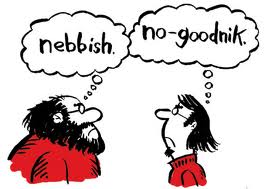 What did I know? I knew nothing.
I was 35 when I married a nice Jewish man from Philadelphia. His mother was small, blond, smart, and very scary. She had told him growing up that she would sooner hang herself in the closet than see him marry a shiksa (non-Jewish woman).
He told me this before I met her for the first time. In the car on the way to her house, I could feel my shiksa self growing ever larger, more Christian, and more alien. So by the time we went in the front door, I felt like a Russian peasant with a babushka and a pitchfork who had just cheered on the Cossacks in their raid of the shtetl (little Jewish village). I wanted to apologize right away.
We got married but not in a Jewish or a Christian way. We were married by a judge in a rushed, wacky courthouse wedding. Not having a big deal wedding meant we could avoid choosing a church or a synagogue – a minister or a rabbi. Besides, my husband would say then — he was Jewish, he wasn’t JEWISH.
But the minute we got married, he suddenly seemed like the most Jewish person I’d ever met. Every two seconds, he’d let loose with some Yiddish word. “I don’t want to deal with all the hazarai (junk),” he’d tell me when he got tired of talking about complicated plans for a weekend. “Stop bubbameisting me,” when he’d decided I was henpecking him. He would alternate the Yiddish with my favorite, moo’ing like a cow to suggest I was being bossy.
“Hey, before you leave, there’s some schmutz on that shirt.” Schmutz? Junk, crud, major lint.
And my very favorite of all time, on a day when I decided to wear a long denim jumper from the thrift store, “Where did you get that schmatta (raggedy piece of clothing)?” That last one has stung for a long time even though I later deep-sixed the jumper in a Goodwill bag and resolved to eschew the Earth Mother look going forward.
There are a bunch of other choice words — mummzer and shicker (both not so nice words). And then there’s Yiddisha pisk which he uses to mean a Jewish face although the Yiddish dictionary says it means loud mouth. So he’s taken a little license with the term. He says that’s how Yiddish works.
Oy, I tell you. What do I know? I know nothing.
I Cracked

I cracked and cut her bangs. “I can’t stand this,” I said and went to fetch the scissors from the City Hall cup on my desk that John Kalwitz gave me when he was president of the Common Council. I have said cup for the obvious reason. I am old enough to have been around City Hall when John Kalwitz was CC president. I am old enough to be a grandmother after all. I am this particular kid’s grandmother as well as grandmother to another little girl in California about whose bangs I never have to worry.
This girl’s bangs make me nuts. I go for months. Ignoring. Brushing them out of the way.
 When they look like this, it’s like Waif Central.
Cute for 30 seconds. And then I’m shuddering in my desire for the scissors.
Then I start the muttering, the arguments with myself. It’s not your place to cut her hair.
For a long time when she was very little, her other grandmother would give her a bowl cut every time Alita slipped into her custody. I loved it. But was conscious of my daughter-in-law’s aggravation with her mother. After all, I would have gone apeshit if my mother or my mother-in-law had cut one of my daughter’s hair. Good f**king grief. The gall.
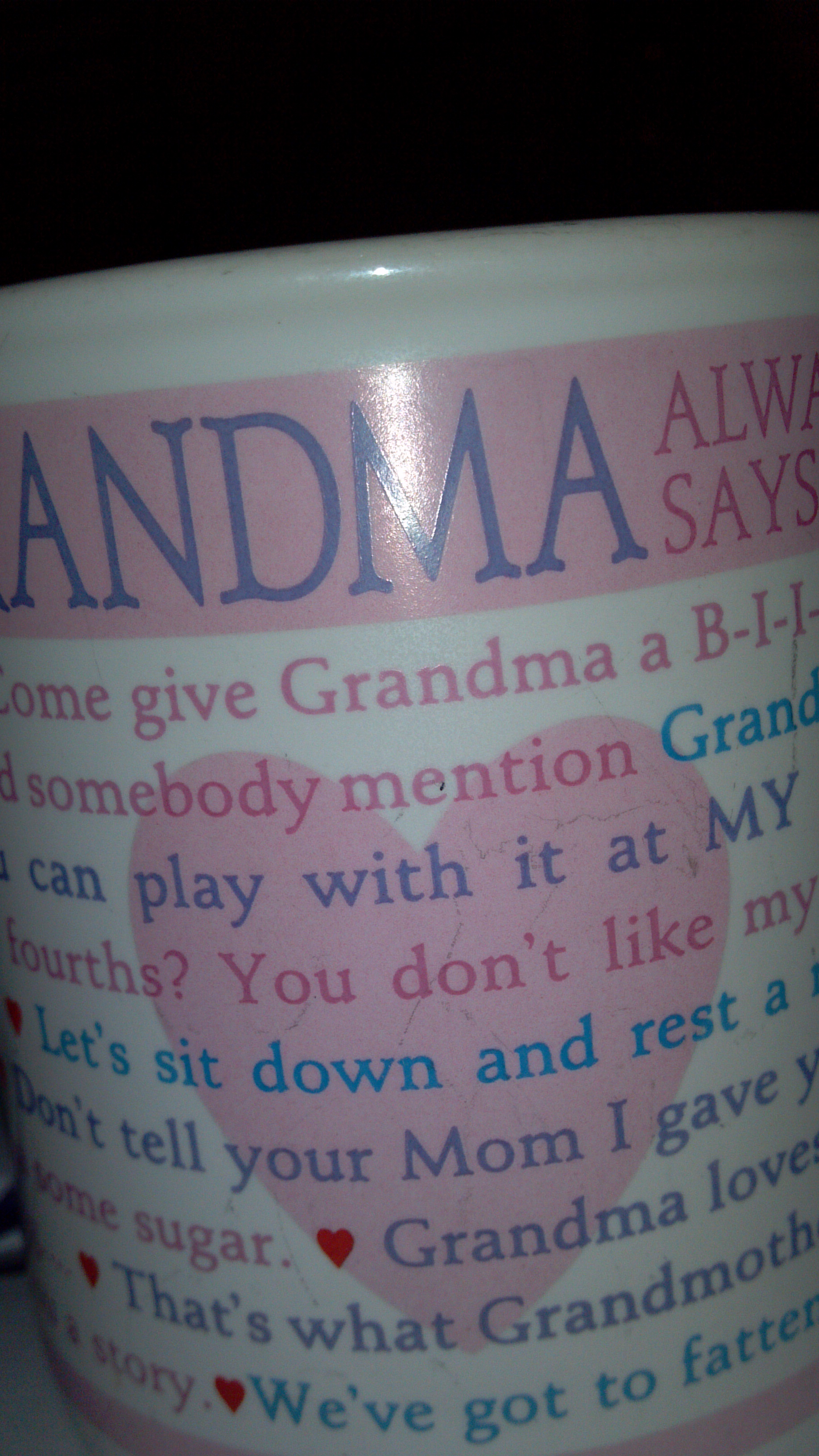
Still. I hate the hair in the eyes. “I can’t see your beautiful face,” sounding like the invisible grandmother on the coffee cup I have downstairs. The one with all the grandma sayings that somebody gave me…..Hi honey, don’t you want another cookie? I think there are some quarters in my pocket for you. Are you cold? Here’s my sweater.
I’ve come to this realization. Many times. But today for sure.
I can only be kind for so long.
Then I have to cut the bangs. And then, as I look at the picture, cut them badly. I’d try to fix it, again with my office scissors, but the outcome is likely to be even worse. I don’t know how to cut hair. I only know how to end my aggravation.
But. I will say this.
She was all smiles afterward. She looked in the mirror and had a big smile. And I figure it was because she could see her own little face for a change.
I’d like to be like the grandmother on the cup. But I’m not.
Screw it. I’m doing the best I can. So sue me.
Since writing this post, I’ve had time to reflect. I’m going back to my rule not to mess with my granddaughter’s hair and put the scissors in a lockbox buried in the forest.
Susan G. Komen and My Toe
 When a Facebook friend posted the news about Komen cutting its support for Planned Parenthood, I had a quick and visceral reaction. Can’t possibly be true. There’s got to be a lot more to the story. I quickly posted a comment. Only semi-indignant. I held back but I was really disbelieving. There had to be a really good reason why Komen would make such a decision — like maybe Planned Parenthood was siphoning off money to buy Mercedes for top executives or holding flashy parties with male strippers who were getting tipped with Komen cash.
I couldn’t believe Komen would do anything so seriously wrong. After all, I’d walked sixty miles for this organization. Twice. Two 3-Days. And I’m not like 25 years old either so it’s kind of a big deal to go strolling for 20 miles three days in a row with a sea of women who could all be my daughters.
But as the news unfolded, it became oh, so clear what had happened. And it made me sick. It really made me sick. I can’t stand stuff that makes life harder for poor people. It’s a major theme in my life. But a big reason why this Komen thing really hit me and I reacted so incredulously and this isn’t a joke, although you will think it is, had to do with my big toe.
It was my first 3-Day walk. San Diego 2007. The first day — we’ve got our new shirts on, our little pink hats, and our little fanny packs and we start walking. And it’s a sensation like no other because first I’m thinking – wow, this is so amazing to be here with thousands of women setting out on the streets of San Diego, we’re a damn army here — and then within minutes, I’m incredulous at my own misplaced bravado. I thought I could walk 20 miles a day? So after the first brave mile, there was 19 miles of faking it.
That night after a ridiculous Lucille Ball-like episode where I lost and then found our tent (which had been hiding about 6 feet away from us at the time), we settled in. And then it happened. The suitcase dropped on my big toe. And hearing, not hearing, feeling the splitting as the toenail pulled away from the nailbed.
Next morning. A lot of bandages, the sock, the shoe, the walking. I wanted to stop every 20 feet, unwrap it and look at the damage. The car wreck in my shoe. I hobbled into the first aid tent at one stop and asked the nurse what could be done. The nurse told me she could take the nail off right then and there or I could keep wrapping it and icing it and soldier on. I remembered the adage about how you can take your mind off one pain by creating another one so I tried to focus on the blisters on my other foot. And tried not to see the little peek of blood seeping through the top of my shoe.
I will say this. I kept on walking. That day (day #2) and the third day. And I walked into Padre Stadium at the end of the 60 miles with my daughter and a massive herd of sweaty, blistered women and got this shirt. And I was so amazingly glad to be done. So relieved that I hadn’t dropped dead or cried or had to have people carry me or ride in the dreaded sweep van. I walked every stupid step.
I felt pride. And solidarity. And gratitude. I felt like I overcame my damn toe and my wimpiness and my wanting to lay down on someone’s lawn and ask for a blanket. All that pink made me strong, man.
Seriously.
So when I first saw the news about Komen’s crappy decision, I just couldn’t believe it. These were the people who made me a tough girl (if only for three days). So I reacted to the news by immediately defending Komen – reflex. Like somehow being in the 3-Day had made the Komen folks my peeps. I think a lot of women across the country might feel like I do – like the organization they stood up for just took them for a ride.
I’m feeling pretty sad right now. Maybe I’m kind of feeling had. Feeling like the solidarity and the pink and the sea of women were more props than real. I don’t know.
Those were some great days.

- Me and my husband and our breast cancer fighting dog, Bow Wow, at the end of the walk.

Start Where You Are, Use What You Have: Involving Dads in their Kids’ Lives

This is week 2 of my little campaign to figure out ways to make my son have fun with his daughter. Last week it was sledding. Today, skating.
Don’t bother me with “you shouldn’t have to do that.” I shouldn’t. But I do. And I am. So lay off.
For the uninitiated, his daughter, our granddaughter, spends most weekends with us (her grandparents) – hence, inviting him to go skating with us at Red Arrow. It’s complicated.
I texted him. We’re skating at Red Arrow Park. Meet us there at 2. Then I sat back and waited for excuses.
I have no idea where that is, he texted back. After I sent instructions, he texted I’ll try.
“You used to do stuff like that with me,” my husband said. “Didn’t you?” “Try to figure out how to make me do things with the kids.”
I admit nothing.
So about a half mile from Red Arrow Park, I got a text. I’m here.
And he was. Sitting in the corner of Starbucks. Texting.
Wearing the same white warm-up pants with the blue stripe that he wore his entire senior year in high school (he’s now 27) and his favorite Klondike traveler hat. 
Ten years ago, heck, five years ago, or maybe last week, this outfit would have driven me nuts. That’s before I had the deep realization that a) no one would ever imagine we’re related and b) he might be just as annoyed at how thrift store dorky I look. We both still really like it – in a weird kind of way – when we act like mother and son and catch funny sidewise glances from other people. We would have been a big hit on What’s My Line?
Walking out to the ice rink in our skates, I told him, “Hey, you know, I have this theory.”
“Yeah. What?”
“Dads make kids braver.”
He’s oblivious. As he is to much of what I say, said. Ever.
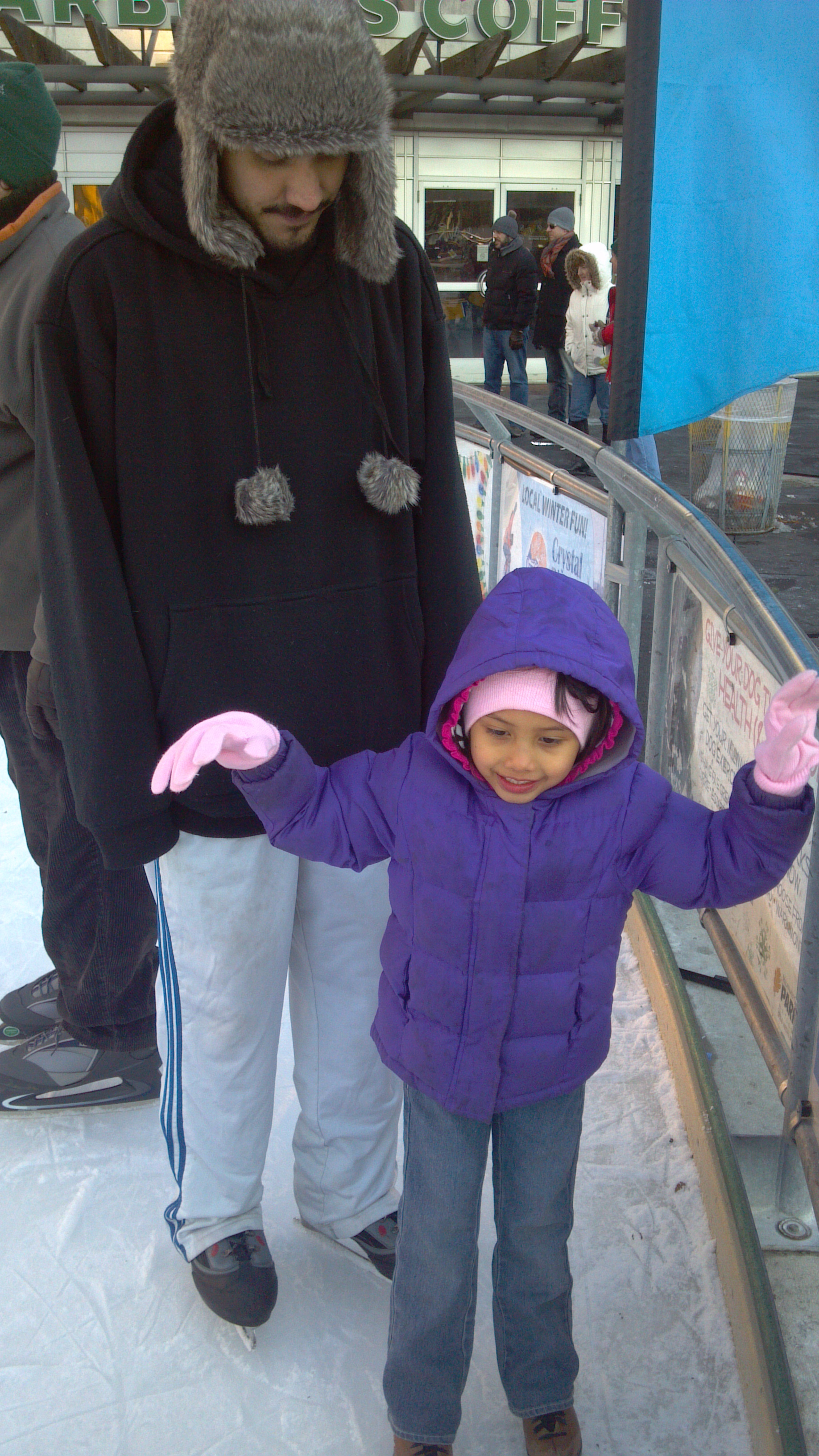
But I’m right. In ten minutes, he’s holding his little girl’s hands, skating behind her and they are going fast enough that her hair is flying out behind her.
She’s grinning. Really grinning.
Last time, she was smiling while she held her grandparents’ hands and inched, inched around the rink.
This time she’s flying. And she’s grinning.
I am so satisfied with myself. La maestra.
Right.
I can’t make life perfect. But I can make sure this little kid can ice skate and I can make her dad teach her.
So that ain’t bad. As my husband would say, “That’s not nothin’.”
Do What You Remember: Involving Dads in Their Kids’ Lives
So yesterday it was a terrific sunny winter day in Wisconsin. Because she had never been sledding anywhere but our front yard, we decided to take our 5-year old granddaughter, Alita, to a big kids’ hill. Her dad, our son, was strong-armed into coming along. It meant that he had to borrow gloves and a jacket to augment his usual summer/winter/fall hoodie attire.
He was reluctant, initially trying to beg off by saying he had to work extra hours. It’s so curious to me that the things he loved as a boy seem such a stretch for him now. He’s either working or tired. An old man in a young man’s body.
Anyway, we brought our two plastic sleds to the top of the hill. At first, she only wanted to push him down the hill.
 Then after a few rounds as a spectator, she decided she was ready.

You can see his joy in the picture.
After doubling up a couple of times with each of us (Dad, Nana, and Grandpa), she said she wanted to go down the hill by herself. Her dad took her over to a small hill to practice. He made a little practice run for her first and then she took her first ride by herself. 
So after the very successful practice runs (see the happy face), she and her dad took the sled to the top of the big hill while the grandparents winced. Too soon. She has no clue how to steer. It’s good we’re out of earshot because he was doing what dads are supposed to do. Assume kids can do stuff. I wrote about this a while ago in a post called What Good Are Dads?
He waited for traffic to clear — for all the criss-crossing saucers and tubes to get out of the way — and he pushed her.
And she just flew. Unbelievably fast. She laid back in the sled and shrieked. 
He ran down the hill after her – seeming to be surprised at how fast she was going but still pretty unexcited about the whole enterprise. We, of course, were ecstatic that she didn’t suddenly veer 50 feet in the wrong direction and hit the solitary light pole at the base of the hill. When they walked up the hill, she looked a year older. More mature. Capable. And really happy.
All this was prelude to the best part. He set her off on her last run down the hill, stood watching for a minute, then whirled around, grabbed the second sled, took off on a run, flopped on his belly, powered the sled with his hands and sailed right next to her.
When they turned around and look up the hill, it was only then that he finally cracked a smile.

Soldier Through: The Adoption Home Study
Adoption socia l workers will tell you otherwise but few things are as daunting as the adoption home study. I personally think that the spectre of it deters a lot of people from going down the adoption road. Guys especially are put off by the idea of a social worker asking a lot of questions. Women? They’re kind of used to over-sharing and are likely to figure that if answering a bunch of intrusive questions about one’s life, marriage, finances, relatives, attitudes, beliefs, and child-raising philosophy is the price of getting a child, so be it.
Most of us have things in our pasts that don’t look so wholesome in the light of day. Poor Newt Gingrich might have something to say about that. But believe me, presidential politics and the muckraking it involves come nowhere near the water-boarding that is the adoption home study.
My husband and I have been home-studied three times – once for each adopted kid. The first time was by far the worst since we had been married only a short time and didn’t actually know much about each other. Alot of the stuff he said in our interviews was a complete surprise to me. Like, huh? The social worker, an overly plump, officious woman who spent a lot of time complaining about her own 16-year old adopted daughter, set him off right away. Each question just made it worse. “How did he feel about my biological daughter?” (He was still figuring that out.) “Would the children be Christians or Jews?” (We had no idea. They ended up being Jews who celebrate Christmas.) He threatened to bail after every interview.
The kicking under the table became the steady beat that accompanied all of our visits with this lady who, mysteriously, changed her name — her FIRST NAME — between home study #1 and #2. So odd.
Then there was the fingerprinting and the background checks and asking people to be references for us. Yuck! The only people we knew who would do this were people who would have to lie about us.
We got through it. To me, the home study was the conversational equivalent of labor and childbirth. Painful, intrusive and then over with. The home study process is comprehensive and lengthy and there are no decent drugs or epidurals. There’s also no sympathy or nice people waiting in the corridor. No one strokes your forehead and tells you that you’re being strong and it’s almost over.
You just feel really, really exposed when it’s done. Sort of like having your legs up in the stirrups. Ladies, you’re with me here?
My advice? Hold your husband’s hand or your partner’s hand or your own hand and soldier through it. Strap on your backpack. Lace up your boots. And just plow through it.
We’re waiting for you over here on the other side.
_________
Another good resource is The Adoption Guide.
A Shadow of My Former Self: How Grandmothers are Different
I’m such a better parent since I stopped raising kids.
Seriously. You know how I know this? Here’s my story. It’s Saturday morning. There is a lot to do to get ready for our annual Three Kings celebration – a gathering of families who’ve adopted kids from Nicaragua. Their kids are now adults and many of them have kids — so now it’s a three-generation thing. (Read Cousins – there are some terrific pictures of our beautiful kids)
Anyway…..I’m on a tear to get going. It being Saturday, we have our little sidekick – our granddaughter, 5 year old Alita. She is a wonderful kid, dreamy, very soft around the edges, ephemeral. Fancy way of saying….she is extremely slow. She finds beauty everywhere. In lint, the sparkles on her shirt, the conversations of her tiny dinosaurs. And of course, she is in her own little Zen state as I hurry her out of the shower and guide her to her clothes.
This makes me crazy.
I point out her clothes and challenge her to a race to get dressed. She says she can’t get dressed because she’s cold. I tell her that she won’t be cold if she gets dressed. She looks like she’s going to start crying. I (nicely) tell her again that getting dressed will solve her problem with being cold. She drops her towel and starts bawling – now completely naked standing on the bedroom rug near, I just then noticed, a slightly opened window.
By now, of course, I’ve ratcheted back into mom mode – my sweet grandmotherly patience as cold as my half-drunk coffee. I am, after all, on a mission to get this damn Three Kings thing going. I decide, just as I would when I actually had kids around here to parent, that she’s old enough to dress herself, notwithstanding the open window.
“Alita,” I said, lowering my voice and taking a very serious stance just like I used to do when my kids were her age, “it’s time to put your clothes on so we can have breakfast and go to the store.”
Now she is not only naked and cold, she is sobbing. I crack. I bend down and ask her, “Why are you crying? It’s just time to get dressed, honey.”
“Nana, you scared me.”

Oh good grief, I thought. I have totally gone soft. Five years old and this kid has never been talked to in a business tone of voice. I am such a f**king grandmother!
It’s like I’m wearing an apron with stenciled teddy bears and a string of chocolate chip cookies around my neck. Where am I? Where’s my edge?
I wasn’t a terrible mother. I just wasn’t really terrific. OK, honestly, I was a little bossy. If this tells you something, when I got my three teenagers cell phones, the oldest one programmed them all to make Reveille the ring tone when I called.
Once when I was furious at all of them after a ridiculously uncooperative visit to the doctor (you take three kids at once to the doctor and then talk to me), my loud lecturing in the car prompted a guy who pulled up next to me at the light to shout out the window, “Lighten up, lady.” You don’t have to ask what I replied, do you?
So naturally I’ve been thinking – would my kids have turned out better if I had been a nicer person? But then I think – hey, they turned out ok and plus, they’re very, very tough. I take credit for that. I do.
Now little Alita? I guess toughening her up will need to be somebody else’s job.
Rainbow Bend

After I had a baby – as in gave birth to a baby – a friend remarked that I had the worst adjustment to motherhood of anyone she’d ever met. She was right. But I was undeterred, going on to adopt three more children. With each new child, my maternal maladjustment was refined, honed, and specialized.
Knowing that I was short on natural instincts, I made it my business to go to a lot of workshops and read a lot of books – especially after I entered the thrall of new adopted parent-ness where practically every waking moment was taken up with thinking, thinking, thinking about my new kids.
Of all the hand-wringing adoptive parent workshops I attended, just one really spoke to me. Here’s the takeaway: When all else fails, order a pizza. The theory, as explained by the expert social worker/foster parent extraordinaire, was that the hubbub and excitement of waiting for the pizza would coalesce the family into a happy hum of expectation.
I liked this concept. It spoke to me. I am big on having things to look forward to. And most of the time, the things are either food or trips.
I love our annual trip to the Florida Keys. I think about it all year — the vista, the food, the funkiness. In fact, I’m happy to say, I’m sitting in the Florida Keys as I write this.
I so love it here. Today, I saw a little homemade placque on the Seven Mile Bridge honoring a dead lady whose ashes were so obviously strewn there and felt envy. Resting with the Stingrays, it said. Wow. That’s so me.
So about three weeks after our newly adopted 7-year old daughter came to the U.S. in 1994, we packed her up in the car with her brothers and drove two days from Milwaukee to the Florida Keys, stopping to sleep in a rest stop because, oops, we forgot to make a hotel reservation in Atlanta and there was the whatever golf tournament they have down there in the spring. This was hard to explain to her — she being pretty monolingual as they say (in Spanish) and her new family (uneveningly lingual, to say the least) — and for a long time on the trip, she thought we were driving her back to Nicaragua.
Where we were driving her was to a resort on the ocean side near Marathon, Florida, where all of us, her big sister from college, and her grandparents were meeting up for a week in the sun.
 It was either before or after that I attended a conference in Chicago about the problems of the Post-Institutionalized Child. The big message of the conference was that parents who adopt children from deprived settings like Romania or let’s say, Rolando Carazo Orphanage in Nicaragua, er, hum, should replicate the deprivation in their homes. Well, not totally, but they should have a very plain room, very few toys, no outside people. You get it? The idea being that kids need time to acclimate.
We didn’t do that. We went to a resort.
Where there was the ocean, a giant swimming pool, people who cooked you breakfast (my mother-in-law was paying), soft beds, TV’s, twinkly lights at night, and a lot of food. Ok – so basically, our little girl went from carrying a pot full of rice across the orphanage courtyard to her little cabin-mates to ordering her eggs over medium at the Kids Eat Free breakfast before she went swimming and sat in the hot tub – all in the space of three very short but truly transformative weeks.
When it was time to leave — to drive the reverse two days back to Milwaukee – I had to tackle her and practically karate-chop her in the stomach to get her to bend enough to get the seat belt on in the car. She was morose and angry as her new parents and brothers tried to explain that the last few days were just a trip, a vacation. Not our real life.
It was a pizza. It was just a pizza, sweetie.
___________
Originally posted in 2012
My Ad for Adoption
 Several years ago, I counselled a young couple who had been trying unsuccessfully to have children. “Why don’t you just adopt and be happy instead of struggling with this?”
Why wrestle everyday with failure (if we want to call infertility failure which I don’t really) when you could celebrate challenge and discovery. Oh forget that.
Here’s the real question: Why go around empty-handed when there are so many kids to pick up?
Here’s a little story that I swear I’ll carry to my deathbed as the defining moment in my relationship with my husband and in the future that we created with our family.
Ours was a second marriage for me, the first for him. I was the mother of a beautiful, tough, kid of all kids 12-year old girl. He had never had children. We tried. Nothing. We tried some more. Nothing. We tested, medicated, tested some more.
Finally, we got the word. No pregnancy was going to happen without major intervention. In vitro — and this was a long time ago — so they were doing in vitro with mason jars and turkey basters. Not for us.
So anyway, as the story goes, my husband and I sat on our backyard picnic table while I told him this death knellish news. “Hmmm,” he said, “I think what this means is that God has something more important in store for us.”
Huh? God? When did my husband ever mention God in a sentence? Never. He just did.
So I packed up my Kleenex, we got in the car, and we went to a Brewers game where we sat high in the cheap seats in old County Stadium along the third base line and I sniffled my way through 9 innings, all the while balancing on my lap my surprised sorrow and my imagined mission from God.
This was a gift my husband gave me — hope. That’s what adoption is, folks. Hope. This little boy in the picture…the thousands of kids who are picked up by strangers who promise to love them. That’s hope.
That’s what you can have in the new year. Hope.
Seriously. There’s a kid sitting around somewhere waiting for you to pick her up.
Here’s a place to start: Adoption Resources of Wisconsin http://www.wiadopt.org/
Christmas Story #3: Redrum
Not being clairvoyant, I don’t really know if other people go around with the same phrase drumming through their heads all day long. This isn’t every day. It’s just some days. Some particularly bad days.
Christmastime brings back memories of one of the more persistent brain boogies —I am blind and my dog is dead.
Many years ago, Bradley Center, Wisconsin Badger Hockey Classic, free tickets given to my husband along with a red long-sleeve Badger Hockey shirt (which he still has, of course) – it’s two days after a sad, rainy Christmas, a month after we had put one of our kids in residential treatment, one day after sending two other kids to dreaded Winter Camp, and hours after we had taken our dog, Davey, for her last walk around the neighborhood, loaded her into the car, took her to the vet and sat stroking her head while the vet gave her the shot that would end her 17-year stay on this earth and in our lives.
There was so much wrong.
Every slam of a hockey player into the wall, every clicking stick, each whistle. I am blind and my dog is dead. The people behind us talking, the woman in the next stall in the bathroom, the guy in the paper hat pouring the beer. I am blind and my dog is dead.
So much wrong. So much failure. So much grief. I am blind and my dog is dead.
I couldn’t make it snow on Christmas. I couldn’t make my kids like Winter Camp. I had to give my child to other people to fix. I couldn’t make our beloved dog live forever.
I am blind and my dog is dead.
I’m not into meditation. In fact, I’m not deep in the least. But I think the thing about a mantra is that it’s sort of like using a magic marker to write the same phrase over and over again until the marker runs dry. And you either have to go find another marker or just give it up.
And because there’s never a decent marker when you need one, I gave it up.
It’s Christmas many years later. Everyone’s doing ok. No one’s dead or in jail. We had a nice day. But some little fleck of the day made me remember that night at the Bradley Center and be glad I wasn’t there anymore.
_______________________
I am Blind and My Dog is Dead is a book of cartoons by Sam Gross. See www.en.wikipedia.org/wiki/Sam_Gross


Snow Door | wisconsinacademy.org
Listen to Jan read her essay “Billy” presented on WUWM’s Lake Effect

Jan’s essay “At the Breakfast Bar” on WUWM Lake Effect

Jan’s essay “The Parish Hall,” on WUWM Lake Effect


“Fury Cannot Touch Me,” Modern Love, NYT, 9/29/11

Recent Comments