Red's Wrap
Happiness. It's relative.
Things My Mother Taught Me — Partly on Purpose
 My mother taught me many things she didn’t know she as teaching me and probably had no intention of teaching me. She also tried to teach me things I had no interest or ability to learn. This is suggestive of a lot of crossed wires between us, however, there were fewer than you might think. I adored my mother but she remains, ten years after her death, the most enigmatic person I have ever met.
She was so much like she appears in this photograph. Tailored, put together. The ever-present pumps. If you could see the backs of her legs, the seams would be absolutely straight. She would be wearing a full length slip that hung, oh, maybe, an inch above the hem of her skirt. And she is looking at the camera but she is holding on to herself. Maybe it was cold there in Niagara Falls in 1938 when this picture was taken but I don’t think so. This is just how she was. Present but within herself.
So what did my mother teach me? Well, here’s my short list.
1. Find a husband with some style.
My mother had just turned 20 when she married my dad, a guy four years older, who had, as they say, been around. He played the ‘horn’ as he called it at honky-tonks around Lansing and, as he told me in one of our midnight chats when he was about 89, “he had never met a really nice girl like her.” Hmmmmm.
Her? I think she was looking for a bit of a bad boy. You can’t tell me every guy walked around looking like that in 1938. The guy really knew how to wear a hat.
2. Make your kids look as cool as you.

My mother was just a great tailored dresser. She didn’t do flounce – ever. She was all about trim skirts and sweater sets. And she was just very cool.
She wasn’t gorgeous. In fact, her most frequent adage to me, and this makes me roll my eyes even typing it….It’s not important to be pretty as long as you’re neat and clean.
She had style and I like to think she passed it on.
3. Be stoic.
This is about what my mother taught me. It’s not necessarily about what I learned. Those things aren’t always synonymous, you know? My mother was very stoic. She absorbed extraordinary stress (which I also have the ability to do) without complaining (not so much). My mother was a ‘put your head down and just get through it’ kind of gal. She didn’t complain about my father’s business reversals. She just hauled out all the neat tricks she learned as a kid in the Depression, like bean soup with just the beans. It took me years and much travel to realize that bean soup could be flavored by something, like….meat.
4. Grow where you’re planted.
She would say this but she couldn’t do this. So I hear this phrase in my head all the time and it’s one reason why I have been loathe to move out of Milwaukee even when there’ve been good opportunities elsewhere. My folks moved a lot and a couple of the moves were uprooting and painful and almost impossible to recover from so my mother was often living in a state of ‘place-grief’. So I think this little adage was meant as a motivational mantra because it wasn’t how she was able to live. She was often too wounded to grow.
5. Peel Potatoes.
I was a latchkey kid. When I got home from school, I’d call my mother at the store – our family business was a Ben Franklin Store where all of us worked starting around age 12…so these calls predated my becoming an employee. So anyway, I’d ask her what to make for dinner. And she’d say, well, not sure, put some water on to boil and peel some potatoes. This was the opening gambit of all her dinners.
What it said to me – then and now – was just start. Do something. People coming home from work and will be hungry? Boil potatoes. Someone sick coming home from the doctor? Turn down the bed. Relatives gathering after a funeral? Make sandwiches. Put on your apron (figuratively) and be useful.
There’s more probably. She tried to teach me to sew but it made me crazy — all those tucks and putting zippers in. She made a dress for me once out of the basement curtains – I kid you not – the dress had tulips along the hem. Remember it plain as day. She could do that. Take down the curtains and make a dress. It makes my head spin.
My mother.
Slut: A Flashback
Do you know who the father is?
Yes. I know.
Do you know who the father is? Slut.
Yes. I know who the father is. He’s the only one.
Do you know who the father is? Slut. Giving it away for free.
I’m not a slut. He was the only one.
Do you know who the father is?
Yes. We were there together when it happened. I know who the father is.
I hope you know who the father is, young lady.
I do. I know who the father is.
It’s going to be very hard for you. Slut.
I know who the father is. We were there together.
We were there together.
Couldn’t Be Luckier

I’ve told this story a thousand times. My husband and I got engaged (so to speak) on February 21st and married a week later on February 28th (we wouldn’t have waited a week had we lived in Las Vegas instead of Milwaukee) all on a dare, double dare. A decision one-upped by one of our kids who got engaged and married within 24 hours by figuring out how to speed things up by going to Rockford, IL. Ok, so Illinois is good at something.
Anyway, this is only interesting, maybe, because we’ve been married for 28 years. If it had only lasted a year, everyone would have said, “See what happens when you rush into things!”
So tonight to celebrate, we went to the Auto Show which my husband loves because he thinks it’s ‘awesome’. He wanders around looking at new SUV’s wearing a hat that my Dad who would be 99 if he was still alive used to wear when he talked cars. He (my Dad) would have a stub of a cigar in his mouth. My husband, at least tonight, skipped that part.
So after the Auto Show, we texted our son who works at a local hotshot hotel to see if he could get us reservations for dinner at their hotshot restaurant and thus get us 25% off the very expensive tab. No go, he texted back. So we headed to our second choice. Walking in the door of the Jackson Grill (actually one of Milwaukee’s most wonderful, hidden restaurants), I said, “Don’t you think most people would have figured out ahead of time where to have dinner on their anniversary?”
Maybe. But not us. We’d rather not know what we’re doing. It’s our best thing. Not having any idea what we’re doing or what comes next. We got married that way, had a bunch of kids that way, and have made ridiculously important life decisions based on nothing more than a nod of the head or the turn of a key in the ignition.
There’s almost nothing better than stopping at the bottom of the driveway and asking, “Are we turning left or right?”
Love that. People plan too damn much. And maybe don’t trust enough.
Not our problem.
What We Can Learn from Ryan Braun
 There are lessons we can learn from Ryan Braun and they aren’t about fielding or hitting. They’re about patience and certitude, control and timing.
When Braun spoke yesterday standing by himself on the field at Maryvale, the Milwaukee Brewers Spring Training Facility in Arizona, he seemed to me to be a person with such deep belief in himself and the rightness of his position that he was utterly comfortable alone. He didn’t need to be flanked by attorneys or supporters. It was just Ryan Braun and the green of the baseball field behind him.
 In my mind, the hardest part of this doping accusation had to have been waiting in silence for the case to be resolved. Even though there were occasional Braun tweets about eventually being vindicated, he kept pretty silent which, to me, signified his respect for the process and his control over his own emotions.
It’s the latter that I think is most impressive. This statement from Braun sums up what that challenge must have been like: “With what’s at stake — this is my livelihood, this is my integrity, this is my character, this is everything that I’ve work for in my entire life being called into question…”
At 27 years old, this ball player had the ability to keep his own counsel and wait. And then when it was appropriate to speak, he did. He didn’t hide behind a lawyer or a publicist. He didn’t issue a statement and refuse questions. He just stood there on the first base line of Maryvale’s field and reclaimed his territory – honest, measured, definite.
Man, I really admired that. A long time Brewers fan, I was never all that crazy about Ryan Braun. But I think I am now.
_____________________
Find the story at http://www.jsonline.com/sports/brewers/Braun_live22412-140317723.html (Photos from the JSonline story)
I Own This Face
 This is my face. For a long time I’ve wanted to disown my face. Years of smoking, laying around in the sun with no sunscreen, using cheap face creams, and basically not caring gave me drapes of wrinkles, some so deep they look intentional. Like how could someone have such significant lines on her face?
Well, my mother did. She sunned and smoked herself so much and so hard that her fair, smooth skin wizened into the face of a Kentucky dried apple doll. Loving her, I followed her path.
All right. It was unwittingly.
So for the past ten years or so, I’ve really been disowning my face. Pretending the crevices weren’t there. Making sure my hair swept across most of my forehead to take care of that rocky landscape. Just stuck in an echo of ‘say it ain’t so.’
But it was and it is. So I’ve set about owning my face. First I had my hair cut impossibly short. This forced me to not only own my whole face but also give up the unsuccessful attempt to hide my two hearing aids. Oh yes, I’m not only wrinkled, I am also increasingly deaf. I want to embrace this.
So like some stereotypical old lady wanting to look young, I got my hair chopped off and spiked, had another hole pierced in both ears, bought a pair of skinny jeans and two pairs of boots and practiced saying, “I might be somebody’s grandmother but I can still kick ass.”
Because being hot is the hardest thing of all to give up. For years, I gave up that territory to everyone younger than me. No more. Too much went into building this little masterpiece. Too many worries, late night phone calls, incredible surprises, kids that elated and disappointed, close calls, and hard work to disown or hide or apologize.
I claim what’s mine. I own it. I own this face.
_____________
The Daily Post prompt: Face
Say It Ain’t So – Rats in the Basement: Part 3
Why Nelson? Don’t take this the wrong way. But he’s my rat. You know how they say that only the rats and cockroaches would survive in a nuclear holocaust. Yeah, well, my son would be right there with them, making a sandwich and watching the only big screen TV to survive the blast. He wouldn’t wonder where everybody went. My other son? Mr. Social. Mr. Teamwork. His lifeblood is his friends and musical theater. I am mother to them both. The miracle and mystery of adoption.
Nelson is oddly impervious to things that drive other people crazy. Like spending his work day in a 2 ft crawlspace installing fiberglass insulation that gets embedded in the skin of his arms. You getting me here? Not like me or you. So I needed him to be our rat – I really needed him. I needed him not to be grossed out or scared of the rats. I needed him to be the front guy. I just figured that, damnit, I had done so much for him and he couldn’t even fucking answer me when I asked for help. I texted again. No answer. Now I despise this kid and his lousy father who just called in to report about his bike ride with his friend around Catalina Island. He was tired, he said. Sad.
Nelson was standing at the back door.
What?
We have rats.
Where?
In the basement. We have to get everything out.
Oh.
We started. The three of us – me and my two sons. Hauling everything that could be moved out of the basement and making a huge pile at the curb in the front of the house. Every now and then I spied a brown flash running from the pile to our house or the neighbor’s house. I tried to act like we were setting up a garage sale and the hamsters had gotten loose.
Deep in the bowels of our basement, oh, so aptly described, I stood looking at the furniture and the paint brushes, papers, and rags and at my sons loading junk into garbage bags, both with bandannas covering their mouths, and I thought what am I doing here? A nice Methodist girl from Michigan with two Nicaraguan men? And then I thought of the prayer I heard my husband say at our table and sitting next to me in the synagogue, “Blessed are You, Lord, our God, King of the Universe, who has kept us alive, sustained us and enabled us to reach this season.”
And I thought to myself. Just stand with me, you guys. That’s all I ask. And that’s what I’ll do for you.
In this basement. With the rats. And the junk. Just stand with me. That’s all I ask.
Don’t ask me questions. Don’t judge me. Just stand with me down here in this fucking 100-year old basement with the crazy ass rat colony.
And take care of me. Because I’m your mother.
And they did.
___________________
What happened later:
- Jerry came on Monday and put out poison/traps for the rats.
- No more dead rats were found. Jerry hypothesized that word got out in the rat community about the sudden deterioration of the cuisine in our basement.
- I saw the Batzner truck in front of other houses on our block.
- My husband came home and we resumed a happy married life.
- The basement was dead to me for two years. Which was good because it meant my husband had to do the laundry.
- In the spring, my husband and Nelson filled all the holes where the rats got in with cement.
- My sons are still my sons. And I’m still their mom. And I know we’ll show up even when it’s a really shitty situation.
- It’s an oddly happy memory.
Say It Ain’t So – Rats in the Basement: Part 2
 Things got worse before they got better.
The next day, the Batzner truck pulled up in front of the house. The driver got out and put on his sandwich sign which said in 2 ft tall letters: THERE ARE RATS IN THIS HOUSE. RIGHT HERE. WHERE I’M PARKED.
I met him on the front porch and we walked around the house. I told him about the Lazarus rat that had been dead but came alive in our garbage cart. I asked him if he could catch the rat. And kill it with something – poison, a shovel, a rifle.
He said. He SAID. And I will remember these words on my deathbed – while the grieving family waits for me to give them parting words and spiritual guidance, I will see the Batzner man with his clipboard, the insignia on his shirt (Jerry), and the policeman flashlight hanging from his belt. Words to live by. You thought there was one fucking rat, Jan, and there were HUNDREDS.
That’s right. That’s what Old Jer said, “Ma’am, you don’t have A rat. You probably have a couple hundred rats. I would say probably 2 or 3 hundred rats are going in and out of your basement.
We went in the basement. It creeped me out even being with Jerry and his big boy flashlight. My husband should be doing this. Bonding with Jerry and the rats. That’s why people fucking get married. To have an appropriate division of labor. But no, my husband is on Catalina Island having heart to heart talks with his friend while I’m in the basement with a uniformed stranger and 300 rats.
He started flashing his light – this corner, then that one. See, that’s where they’re getting in. My buddy Jer explained how the rats had a network of tunnels underneath the house, that led to burrows into the basement. He pointed out the gnaw marks with the tip of his pencil and I could see how their little sharp wicked teeth had drilled through the wall leaving little excavation mounds.
Jerry checked off all the things that attracted the rats – easy access because of the age of the house, stacks of magazines and newspapers, old furniture, paint brushes and rags, and a giant bag of dogfood with, yep, little rat lip prints on the bottom corner. When you get all this stuff out of here, I’ll come back and set the traps.
I called my husband. His response? Ah, there aren’t 300 rats. I don’t know what he’s talking about. I’m not even sure there was one rat. Looked like a mouse to me. Just leave it and we can clean it up next weekend. (This is what’s called Howard’s Housework Scheduling Program (HHSP). Using HHSP means that when a need for any household intervention arises after 6:00 p.m. Friday, it can only be scheduled for remediation after 6:00 p.m. on the following Friday. This is how we live, folks. I’m not making this up.)
Obviously, there was no way in hell I was going to clean the basement by myself. Or sit upstairs drinking Scotch while the rats played cards downstairs.
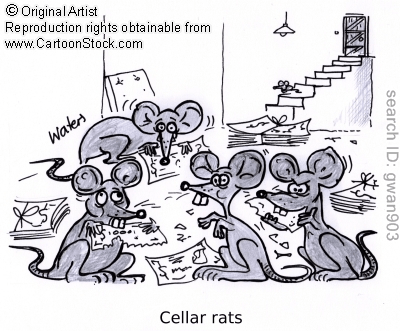 My only kid within reach was the one I love having lunch with. Loyal, funny, chatty, and helpful, Joe was not my rat man.
This job required his brother. The same brother who I actually would have killed with a shovel had he graced my front door during the previous three months. It was either deal with Nelson or wait a week.
I texted: Nels. Come over tomorrow at 9. I need your help. And don’t ask any questions.
Tomorrow: Rebuilding Relationships with Rat Shit
Read more about Norway rats here http://www.batzner.com/pest-database/rodents/norway-rat.asp
Say It Ain’t So – Rats in the Basement: Part 1
This is a story I’ve thought of telling many times but it’s always been so hard to get my arms around it. You know. Stories about rodents are just so very hard to craft well.
My story started when I saw this creature in my backyard laying under a tree. As still as can be.
 That’s a rat. I told my husband.
It’s not a rat. It’s just a large mouse. We live in the city. There are mice.
Mice aren’t that big. It’s a rat. There’s a dead rat in our yard. If there’s a dead rat in our yard, there’s probably a live rat IN OUR HOUSE.
My husband uses denial of reality as a primary labor-saving device. So if I tell him that one blade of the ceiling fan is hanging inches lower than the other blades and is about to fly off and decapitate us, he will say, first, What fan? I never noticed a fan.
And then, after being forced to recognize the existence of the fan, will say, Oh, that fan. No, I don’t notice anything different about the blade hanging 12 inches lower than the others.
So because he is basically gallant, especially when pressed, he picked up the dead creature in the backyard with a shovel and put it in the garbage cart.
Then he said, Fine, if YOU think it’s a rat, I’ll call the exterminator tomorrow and have him come out here. But, you know, I’ll be gone so you’ll have to deal with it.
The next morning I dropped him off at the airport for his annual weekend with his best friend – this year, they were going to Catalina Island. I was going home to the very large dead mouse in my garbage cart and the exterminator who was coming the next day.
That night, I took out the trash. Heaved open the lid of the garbage cart and right away saw it.
The hole.
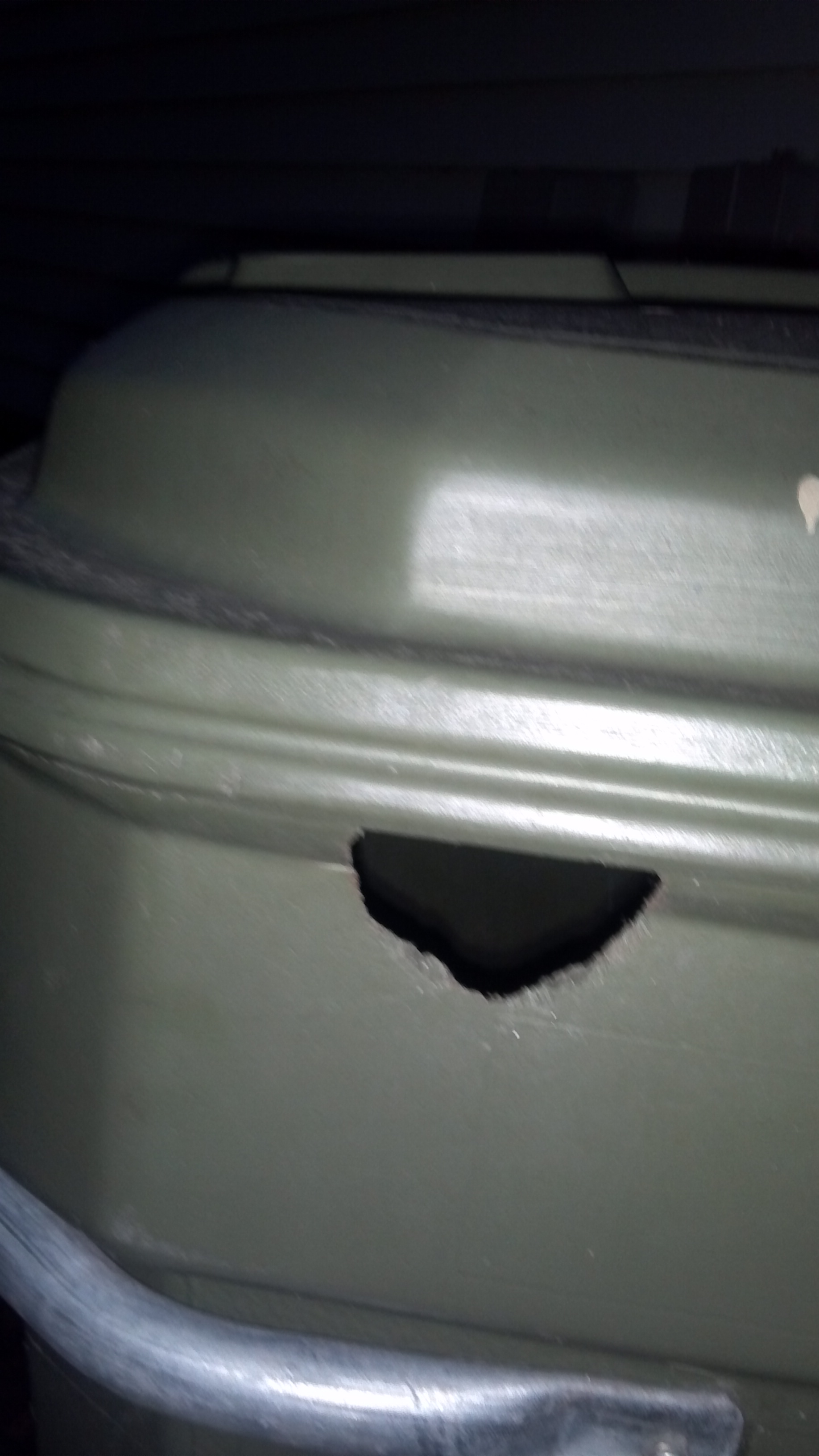
Holy crap. Not only is this not a mouse, this is a live rat. A live, motherfucking rat that is running around out here with me in the damn dark or already in my house waiting for me with his big awful teeth and that horrible tail. IN MY HOUSE!
I hate my husband.
Tomorrow is Part 2 of this lovely story.
See how rodents show the way to family bonding.
The Power of I Am Sorry: Mending Family Estrangement
I’m resurrecting this piece that I wrote several years ago about my long term estrangement from my parents. It’s the story about how 10 years of silence ended. It also was the first serious personal essay I wrote. It just goes to show that the most important thing about writing is to have something to say. And I had something I had been waiting a long time to say.
Every once in a while, especially around the holidays, I like to put this piece out there to remind people that if you think it’s too late to make things right, you’re wrong.
The title of the piece which appeared in Newsweek Magazine in September 2008 was The Power of ‘I Am Sorry’; the title’s been changed a bit to The Power of Saying You’re Sorry. I actually like that better.
Mario
 I fell in love with a little boy in Nicaragua 18 years ago. Tonight he’s recovering from surgery in a hospital in North Carolina. There’s a story here.
I met him when I went to Managua to bring back our newly adopted 6-year old daughter. That’s her. The one in the red shirt with bangs and a little pageboy haircut.
Every day for a week, I would go to the orphanage and we would hang out, she and I. Each of us being monolingual in our own way, we spent a lot of time drawing pictures and practicing writing her name. Generally, we would sit on the floor of the toddler hut amidst kids in playpens and kids in walkers.
That’s where I met Mario.
He was a little guy – maybe two or two and a half. He buzzed around us in a walker, one of those that have a sling seat surrounded by a little plastic table, four wheels. He zoomed into us, around us. And even as he sped around it was obvious that one leg was ok but the other one wasn’t.
What’s wrong with Mario? I bugged my Spanish-speaking friend to ask the workers. Ah, his leg is not good.
You can ask questions all you want in Nicaragua. Doesn’t mean you will get answers.
Mario was beautiful with a round face, big brown eyes, a constant smile. So friendly and busy and happy. But I was obviously already committed and the girl I had come to get was herself beautiful, friendly, busy and happy. I could have no complaints.
Plus that wasn’t the way it worked when we adopted from Nicaragua. We didn’t get to shop. Children were chosen for us – actually by a single very remarkable woman who headed the country’s human services department. At the time, I thought God spoke to her. Now, I think God spoke to her.
Anyway, when I got back, I tried to start a family campaign to adopt Mario. It lasted five minutes. My husband, accurately determining that we were already over our heads, said no.
But because Nicaragua’s focus at the time was on helping kids with disabilities get adopted in countries with first world medicine, like the U.S., the authorities there sought another home for Mario.
And they found one. A family in Racine that had already adopted a little girl from the same orphanage was ready to adopt Mario. They did. They were already part of our little band of Wisconsin Nica adoptive families – about ten of us who had adopted from the same orphanage. And so it happened that the same little boy who zoomed around in his walker in Nicaragua would visit my house in Milwaukee and do the same thing. For several years, I would see him at least once a year at our annual Three Kings celebration and then his family moved across the country and we lost touch.
Enter Facebook.
Through a friend I connected with Mario’s mother and then I saw the pictures of Mario as a young man. Mario with his parents and his sister. Mario now a very handsome guy with the same beautiful eyes and terrific smile. Wow, he grew up. I am so happy that he grew up.
And then the news of chronic health problems related to the condition of his leg, of his mother searching for solutions, of recurring stays in the hospital, of long, difficult nights, and a lot of reaching out for prayers. And I sent up my prayers although I am not what one would normally call a prayerful person.
So all of this causes me to think alot about fate and how orphaned kids end up with particular families. When we say an adopted child is chosen, who really is chosen? Is it the child or the new parents? I don’t know.
I do know that this child – this Mario who so caught my heart so many years ago – found the mother he needed. And it wasn’t me.
So in my own not very prayer-oriented way, I pray for her and him tonight. That he heals quickly and good and she can rest and enjoy her son.
That’s it. That’s my story tonight.


Snow Door | wisconsinacademy.org
Listen to Jan read her essay “Billy” presented on WUWM’s Lake Effect

Jan’s essay “At the Breakfast Bar” on WUWM Lake Effect

Jan’s essay “The Parish Hall,” on WUWM Lake Effect


“Fury Cannot Touch Me,” Modern Love, NYT, 9/29/11

Recent Comments