Red's Wrap
Happiness. It's relative.
Ask Me No Questions, I’ll Tell You No Lies
 One of the freaky things about having a blog on WordPress.com is that I can see the search terms that people use that brought them to my site. Sometimes, it’s pretty distressing, like when I posted about it being so hot when I adopted one of my kids in Nicaragua that the Russian girls in the rooming house where we stayed were running around in their underwear. Oh dear, you do not want to have Russian, girls, and underwear in the same blog post. You get a lot of grimy, slimy hits on your blog and will end up wanting to disinfect your keyboard every 20 minutes.
So today, I was doing one of my regular checks on how many people have read Red’s Wrap and saw that someone had gotten to the site by googling: How old is Jan Wilberg?
So I looked at my husband across the room and said, “Hey, somebody got to Red’s Wrap by googling How old is Jan Wilberg?” “Who would do that?” he asked.
Seriously, WHO would do that? I thought about a potential new business partner. I supposed he/she might do that although looking at LinkedIn would lead you pretty quick to a reasonable estimate. (Because I frogged around in college, it does shave a few years off my perceived age.)
So then I sat thinking, “How old is Jan Wilberg?”
Well. She’s old enough to know better (one of my father’s favorite sayings so had to lead off with that, whatever it means). She’s old enough to have watched the Nixon impeachment hearings with a baby on her hip. Ok, she’s old enough to remember watching the Army McCarthy hearings on a black and white TV while her mother was doing the Tuesday ironing. She’s old enough to have her father tell her he was sending her to college to find a good husband.
She’s old enough to have campaigned for Barry Goldwater, fall for a black guy, and become a Democrat almost overnight. She’s old enough to get on a bus in her college town, ride to a downtown Detroit motel and have an illegal abortion because she made the mistake of getting pregnant BEFORE Roe v. Wade.
She’s old enough to be sitting in high school English class and listen to the principal tell her the President had been shot and old enough to see his assassin shot by Jack Ruby on TV. She’s old enough to watch men walking on the moon on a 12-inch TV in married student housing at Michigan State University and go outside to look at the moon that same night and wonder how it could be.
She’s old enough to own the best music of any generation, old enough to think Mick Jagger still has his shit, old enough to not give a flying fuck about how old people think she is. And old enough to think freedom’s just another word for nothing left to lose.
She’s old enough to wonder why somebody’s wondering how old she is, old enough to worry that her age might make people draw wrong conclusions about intelligence or her competence. Old enough to worry that people might make assumptions about her based on her age.
Old enough to wonder what the hell comes next.
But she’s also old enough to know about luck, good fortune, and acceptance. Old enough to understand gratitude and small moments. Old enough to be smarter than she has ever been before and know it.
Old enough to look forward to what’s next.
That’s how old she is.
So there, little mystery googler. That’s how old she is. All you have to do is ask.
Thank you, John Edwards
He did so many things wrong and today he finally did something right. He owned up. He said he had sinned and that no one was responsible but him. Maybe it was a ploy. I am a sucker for apologies and am hooked on the notion of redemption and starting over so I’d be fair game for a good con especially by a handsome guy.
But he looked different to me today. Not so handsome. Worn. His tie showing at the bottom of his buttoned jacket reminded me of the guys who get dressed up for a wedding having forgotten how to tie a tie to the right length. A little bit of his inner ‘hick’ seemed to be showing through.
I mentioned all this to my husband who, naturally, asked me the unexpected question which was “If you were his wife, would you be so impressed with his apology?” Of course, I don’t know what his wife would have done. I do know that most people will forgive almost anything if the transgressor owns his sin.
Tomorrow, Bill Clinton is coming to town to campaign for Tom Barrett for Governor. This is the same guy who stowed his White House intern conveniently under his desk just in case any special needs came up. But hey, he finally, finally, finally admitted to what he had done and presto/chango, he’s a statesman, a diplomat, a hero of the people, and the cutest good ol’ boy ever.
Man, you don’t need to be perfect in my book. You just need to be straight. If you fuck up, say it. That’s what John Edwards did today. He said it. He sinned. He sure did.
And then he said, “God isn’t done with me yet.”
That’s so true. Now’s the time for redemption.
http://www.cbsnews.com/8301-501363_162-57444968/edwards-acquitted-on-1-count-mistrial-on-others/
Say Thank You

In the adoption world, it’s not cool for a parent to think that her kids should be grateful. When strangers come up and coo about how lucky your kids are to have you as their mom, you’re supposed to say, “Oh no, I’M the lucky one.” This is a conversation that takes place when adopted kids are really little, typically sitting in the grocery cart in the check-out line, looking so obviously adopted and cute beyond words. It’s then that the lady in the next line who’s been eyeing you up and down the cereal aisle lets loose with what she’s thinking. First, it’s “where are they from?’ and then it’s “they’re so lucky to have you.”
At that point, when the kids still fit in the grocery cart, an adoptive mom is grateful beyond all possible words. In that moment, it’s true that the gratitude flows from her to them. The adopted children made her a mother or made her more of a mother or fulfilled something, stilled a yearning, made her worthwhile.
When they are little, there’s no question that expecting them to feel gratitude for being adopted is crazy. They didn’t asked to be orphaned nor did they choose to be adopted. For my kids, being adopted also meant leaving their country and their culture. They lost a lot that could never be recovered.
But the equation figures differently now that they’re grown. And never did I feel that more than on Mother’s Day. On that day and in conversations at other times, I’ve felt a deep shift in our relationship. Where sometimes I’ve felt their blame, their anger, and their deep unanswerable longing for their original parents – a ‘hunger of memory’ that an adoptive parent cannot satisfy no matter what she does – on Mother’s Day, I felt their gratitude. And I should. I earned it. They should be grateful. Raising them was really hard.
It makes me happy that we have gotten to the point where we can be grateful to each other.
It changes everything and changes nothing.
Somewhere Over the Rainbow

There are few things as strange as having your place burn down. I know this. It happened to us. Yesterday, it happened to the people who own Rainbow Lodge, the motel deep in the deep of Michigan’s Upper Peninsula, the place on the fabled Two-Hearted River where ordinary Joes could feel like Hemingway for a day. The Duck Lake Fire had overcome Rainbow Lodge and it was gone. Just plain gone.
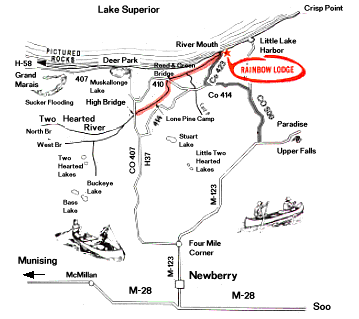
Today we drove out H-58 east of Grand Marais, MI, to take our dogs for a walk in the forest and we saw the sign for Rainbow Lodge – Rent Canoes on the Big Two-Hearted River – 33 Miles. Every time I see the sign I think of Hemingway’s alter ego Nick Adams getting off the train in Seney and hiking all those miles with his knapsack full of cans of pork and beans. I don’t think Hemingway really hiked all that way – I think he just liked the name – Two-Hearted River. I think he really went fishing in the Fox River, but does it matter?
Rainbow Lodge wasn’t fancy. Don’t think it was a big, beautiful log cabin with stoked fireplaces and glittering candles. I never stayed there but it looked to me like a typical U.P. place which mostly means neat and clean shelter. Thin walls, double beds with sensible bedspreads, big, fat TV’s sitting on dressers, and free coffee from the urn in the lobby in the morning. Its charm was its existence not its ambience.
The aftermath of a fire is indescribable. We were gone when our house in Grand Marais burned down and we didn’t come back for two months because people told us there was nothing to see, nothing to save. But when we came back, we saw plenty. We saw shards of the blue dinner plates sticking up through the snow. We saw the embroidered edge of a pillowcase. We found whole tiles from the upstairs bathroom. And we saw nails and glass everywhere from when the house blew apart from the heat.
It was sickening in a strange, archeological kind of way. It was interesting finding these things and remembering how a few months before they were part of an intact house. But it was also so awful. What we had was gone. There was nothing there but little shards that would fit in a cereal bowl.
So I am sad for the people who own Rainbow Lodge, the folks who kept Two-Hearted River a place people could go and imagine themselves with a knapsack and cans of pork and beans. I wonder if they are finding the shards of dinner plates that just a few days ago held people’s suppers. I don’t have to wonder if they are sad because I know they are. I know, too, that folks who drove up from lower Michigan or came from other places are very sad that the place that made summer special and their adventures real is gone.
There is just nothing like it – having your place burn down. I know. It happened to us. We started over. I hope the Rainbow Lodge owners do the same.
___________________
Here’s news about the Duck Lake fire current as of 5/30/12: http://www.freep.com/article/20120530/NEWS06/120530055/Michigan-upper-peninsula-wildfire?odyssey=tab%7Ctopnews%7Ctext%7CFRONTPAGE
The Six O’Clock Call
At six o’clock she turned down the stove, picked up the receiver of the yellow phone on the kitchen wall and dialed the number of the place her son was living.
She could hear the guy at the desk yell down the hall, telling her son that his mother was on the phone. “Come and talk to your mother. Tell her about your day.”
Long minutes passed. She listened to papers rustling and the distant voices of other boys. Every night she came to the point of deciding to hang up and call again. Why does it take so long? Every night I call at the same time. Wouldn’t he expect me to call?
Finally, her boy came on the phone. “Hi Ma,” he whispered and she could sense his head bent over the phone and see him looking down at his shoes. “I was on green all day.”
A green day was better than a yellow one or, certainly, a red one. Being on green meant that he’d done what was expected, obeyed all the rules, participated in group, agreed to his imprisonment. He hadn’t struggled like he had on so many other days, the ones when he reported that he was on yellow and gave his story, always of the most minor of infractions, of why his name had the yellow magnet next to it. If he was on red, he couldn’t tell the story because he wouldn’t be allowed to talk to his mother or anyone else. He’d be alone in his room.
“That’s good, honey. I’m proud of you. Stay on green tomorrow, ok? I’ll call you tomorrow. Stay on green.”
She turned up the stove so the water would boil for the pasta. The sauce, out of a jar, was just starting to simmer. The night would pick up where it left itself before the call, everyone closing around to fill the hole.
They could sit at the kitchen table now because there was one less person. The dining room stayed dark most nights. The little table in the kitchen nook was just fine, symmetrical. It made dinner cozy and peaceful, protected and safe. And very quiet.
Loading the dishes into the dishwasher, she asked the same question as every night. By now it had become her secret catechism, “Did we do the right thing? Yes, we did the right thing. Did we do the right thing? Yes, we did the right thing.”
“Did we do the right thing?”
______________________________________
 This piece was written in response to a Write on Edge prompt to write 400 words relating to a choice or consequence of a choice.
One Kiss
 You only need one kiss. On Mother’s Day. Or any day.
You don’t need dozens. Just one.
To kiss or be kissed. It’s the same.
That’s all you need. Is one.
100 Posts and One Little Girl
 Every Saturday we take our 6-year old granddaughter to a Rec Department ballet class in a nearby high school. The class meets in a room used by the special ed program; every week, there are new questions written on the board. “What will you do after high school? What is your vocation?” I especially like the random words cut out and pasted to the wall – ambition, goals, income, success – and harbor a secret wish to be 18 again so I could get the true 411 from whomever is teaching this amazing class. Then my life might not have been such a WTF series of unfolding events.
So back to the ballet class. The Saturday class draws an interesting bunch of girls. They all come in their little leotards, some of them have little ballet shoes, some don’t and those girls go sliding around the polished concrete floor. The parents/g-parents sit and watch since it’s a schlep to drop off and go home. We read. I do crossword puzzles. Every now and then we look up and at least 50% of the time, we’ll see Little Blonde Girl with her hand to her mouth standing against the wall motionless. Her mom, sitting at a school desk across the room, continues to read her book but I can feel her seeing her daughter standing at the wall.
She looks up at her daughter and I can feel her not wanting to give her daughter any signal that should should run across the room to her.
The week before she had gotten upset and walked her daughter out of the room and down the hall. There was stern talking-to going on out there in the hall. But it was to no avail. Little Blonde Girl came back and took up her place again next to the wall.
Today, I could feel the war going on in this mom’s head. Should she just grab the kid and go home? Should she act like nothing is out of the ordinary? Should she be sympathetic or critical? Should she keep pretending that she’s not really annoyed and embarrassed and exasperated and wondering why her child, the child who begged to take ballet classes and mooned over the $5 leotards and tights and little pink slippers at Walmart, the same kid who prances around the house and wants to read all the little books about that dancing bunny, why is that child standing there while all the other little girls are twirling around and smiling. I can feel her thinking why is my child so strange?
And I want to go over to her and divulge the fact that I know what she’s thinking and tell her, “Hey, it doesn’t matter. It’s not a test. Not for her and not for you. It’s an $18 ballet class in the basement of the high school. She’ll be ok. We’ve all been there. All our kids are strange.”
It wasn’t my place to comment. Just my place to know.
_________________
This is my 100th post on Red’s Wrap.
Dare Double Dare
 This piece is written in response to a Write on Edge writing prompt to start with the sentence, “His crossed arms answered her question before she spoke.” 450 word limit with a focus on dialogue and body language. This was painfully difficult since I never write fiction and rarely even write in the third person. But the point was to try something new. So I did.
Dare Double Dare
His crossed arms answered her question before she spoke.
She asked anyway. Better to hear his answer than just suppose it.
“So you’re going to stay here even though…………..”
“Sure. Where would I go? It’s my house, too. I should just move out because you decided to fuck everything up?”
He shifted his weight, still leaning against the stove. One of the burners started the tick, tick, tick that signaled the flow of unlit gas.
“You’re going to blow the house up, leaning like that.”
“You already took care of that. Our house is pretty blown up if you ask me.”
He turned to reach for a glass from the cupboard, poured himself a Scotch, sat down on the kitchen stool and waited for the next foray.
She made the motions of starting dinner, taking the old black iron frying pan down from its hook over the radiator, and rummaging in the refrigerator for the chicken breasts she’d bought that afternoon.
“Where’s the olive oil?”
“How the fuck would I know? You’re in charge of the olive oil, the regular oil, the peanut oil. There’s an oil, you’re in charge of it. Isn’t that how it works? You’re in charge?”
“Jesus, you don’t have to be so mad. I’m just trying to make dinner here.”
He got off the stool to reach for the bag of Doritos on top of the fridge, a subtle insult to her cooking.
“Is there any way out of this? Is there any way that you aren’t so mad at me?”
He went back in the refrigerator, getting on his knees so he could look long and hard behind the yogurt, the radishes, and the eggs. He stood up with a bag of Habanero chilies.
“You want hot? Here’s hot. Why don’t you cook these for dinner.”
Two Boneheads Go To Dead Couple’s Pass
The Vacation Choices http://vacationchoices.com/ salesman sat down in front of our table, took a pen out of his pocket and started to sketch out the remarkable, life-changing savings we’d experience if only we would hurry up and be the first couple in the room to sign up for a $9,999 membership with an annual service fee of $390. For that, we would get incredibly cheap rates on air fare, hotels, and everything else associated with luxury travel. We could to to Vegas and stay in the best suite for $50 a night, look at the Eiffel Tower out our window for mere francs, stay in a house on stilts in the shallows of the ocean and watch the fishies through the glass floor at night (how could it be glass…it was something you could see through). This last one almost put me over the edge. There is absolutely nothing that I love more than water and vista and then to add FISHIES!!!
“Sorry, we’re not buying,” my husband told the guy after he’d finished his remarkable analytical drawing of how much money we would save. I wondered how many times that day he’d drawn the same thing. Did it work? It’s a powerful sales tool. My dad used to use that technique when he sat down with poor folks in Detroit to sell them a new Muntz TV with a genuINE silverized picture tube, whatever that was. He told me later, only a little embarrassed, that all picture tubes then were silverized but that it sounded good and made people want to pay the extra money. Ok, Dad.
After the salesman got the message that we really weren’t buying, he told us that, in order to get our ‘free’ tickets, we had to stay another hour. It seemed like our punishment for not falling for the sales pitch. Fuck you, I immediately thought, and then I reconsidered. Golly, if we’re really going to get two free tickets to Hawaii and three nights in a hotel for coming to this sales presentation, we can figure out how to sit here for an hour. So my husband and I started to yak. This is our best thing. We never have moments of silence.
So what we started talking about was how all these places that the Vacation Choices looked great but what we really liked to do is to be where nobody else is. Which is how we ended up almost going up Dead Couple’s Pass.
We were driving back to Wisconsin from California in November. We drove through Yosemite, through the Nevada desert and then north to Yellowstone, aiming for the entrance that was still open after the early (November 15) winter closings. We took that open road through Yellowstone. It was dusk, getting darker by the minute. The road was clear but we were happy to end up in a small town just outside the park limits. Big question was – do we press on to Cody, Wyoming, or stay put?
“Let’s just press on,” my husband said. He always had six more hours of driving in him no matter how far we’d gone. But when we reached the road out of town to Cody, the sign said ROAD CLOSED. We stopped in a gas station. “So what’s the deal with the road closed?” we asked. “Ah, it’s nothing. We’re all still using the road. It’s just the officials getting extra cautious. The road’s fine. Go ahead.”
It was snowing.
My husband and I have a thing. Neither of us wants to look scared, especially him. Basically, we were contemplating taking a road that was a pass through the mountains at 11,000 feet, in the pitch dark, in the snow. I took him off the hook this time by telling him that we’d end up like the people we’d read about who had gotten stuck in the Rockies and ended up eating their shoes. Besides we had BowWow in the car, our faux brave Bischon, who had spent the trip perched on the console between us making us the perfect Travels with Charley dreamboat. The prospect of getting stuck in the snow with our little circus dog was too awful to contemplate so I told him it was freaking me out and we needed to stay in town.
So we went back into the little town where they had all told us not be afraid of the stupid, over-cautious ROAD CLOSED sign and we went to the only motel there was. Bates.
They opened the kitchen for us and while we waited for dinner (fried chicken – that’s what there was for dinner, don’t get fussy), a cat walked around our table, making it clear who was on whose turf. We ate and went to bed in a room with the plywood feel that I know so well from life in the U.P. Thin walls, thin doors, and, in this case, plenty to see outside including a buffalo in the yard. At 4 in the morning, BowWow pranced and barked (as Bischons are prone to doing), alerting us to the man ‘out back’ who was what? shoveling snow? Who knows.
We could NOT wait to leave in the morning. We packed up, went briefly to inspect the road to Cody, saw that it was really snow-covered, turned the car around, went back through Yellowstone, leaving Dead Couple’s Pass for another couple of fools, and we happened on the most extraordinary occasion of a beautiful pack of wolves just across the river from the road walking about in the white. We would not have seen them had we not turned back.
The accident of that, not knowing what happens next, only having our car and each other, a credit card, and a sense of humor – that’s my vacation choice.
Oh, by the way, the free airline tickets? Hmmmm. $100 plus $75 for each person plus……you get the idea. Don’t do it, folks!


Snow Door | wisconsinacademy.org
Listen to Jan read her essay “Billy” presented on WUWM’s Lake Effect

Jan’s essay “At the Breakfast Bar” on WUWM Lake Effect

Jan’s essay “The Parish Hall,” on WUWM Lake Effect


“Fury Cannot Touch Me,” Modern Love, NYT, 9/29/11

Recent Comments