Red's Wrap
Happiness. It's relative.
People You Can’t Forget: Jane
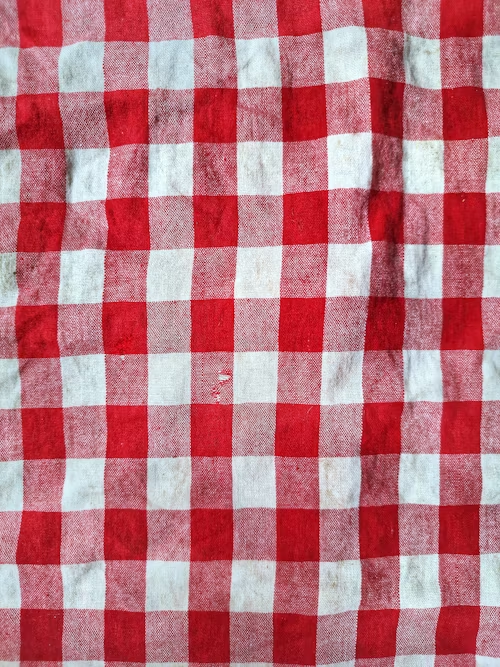
I don’t know why but all day I’ve been thinking about Jane. Two memories collide — the pungent, overpowering body odor wafting down the hallway that announced her arrival minutes before she appeared in my office and the matter of fact way she cinched up the tablecloth she would often wear as a skirt as she began to expound on some critical southside neighborhood issue. When she came to Resident Council meetings at the antipoverty agency where I worked, the other members would scoot down to the end of the long table and start lighting matches. It was awful to witness. She seemed not to notice, but she had to.
She sat with pride, in her tablecloth, in her halo of foul smell, representing her neighborhood because, you see, she was elected to be a Resident Council member. She was there to do her job and she almost never missed a meeting. She walked into meetings, the dirt in streaks on her bare legs, wearing slippers sometimes, sometimes shoes, an old sweater or maybe a filthy parka, her grey unwashed hair straight and pulled behind her ears. She never, ever bathed.
She was so ill. She wanted help, but then she didn’t want help. Mostly, she wanted to talk – about why she couldn’t stay in her house. How it was dangerous to stay there. How she had gone to college and was trained to be a scientist. About her parents and how much she missed them. About how people shunned her, how they were rude and cruel.
One day she came to our agency asking for help getting to County Hospital. She told a story about the bus driver not letting her get on the bus. She didn’t say why but we suspected the reason. My boss called a cab and I rode down the elevator with Jane – all the while trying to pretend that trying not to pass out from the smell and talking to a woman wearing a tablecloth with nothing underneath were everyday things.
I never said, “Jane! You need clothes. You need to take a bath. You need to see a doctor. It isn’t healthy to live like this.” I never said that because, I think, I was trying to be respectful of Jane. I thought Jane was entitled to be treated like everyone else. And in my mind, at that time, that meant pretending that her condition was normal.
But was that respect or just my fear? That if I pushed her to accept my help then I would then have to help her. Myself. Not my agency. Not the case manager down the hall. Me.
Looking back, I think I was hiding behind that notion of respect. Because it was safer for me. But it was a fiction. A complete entry into unreality — where my practice of respect somehow prevented me from actually figuring out how to help her and let me give up on the idea of helping her almost instantly for fear of insulting her. Totally nuts.
I’d like to think that if I ran into Jane today, I wouldn’t be afraid of how ill she was, how impossible it seemed to help her. But I’m not so sure. It’s hard to know. Very hard.
______________________
Photo by Harisankar Sahoo on Unsplash
One Comment on “People You Can’t Forget: Jane”
Leave a Reply


Recent Comments
 | loudly113a2da65d on #20 of 92: Point the Way |
 | Liz Levins on #19 of 92: Sailing on the Purp… |
 | Shelly on #19 of 92: Sailing on the Purp… |
| #17 of 92: Struggle… on #16 of 92: Struggle at the Esc… | |
| Shelly on #15 of 92: Baseball is a Metap… |

Snow Door | wisconsinacademy.org
Listen to Jan read her essay “Billy” presented on WUWM’s Lake Effect

Jan’s essay “At the Breakfast Bar” on WUWM Lake Effect

Jan’s essay “The Parish Hall,” on WUWM Lake Effect


“Fury Cannot Touch Me,” Modern Love, NYT, 9/29/11

Yup. (another yup) That thin place in which you don’t want to tell people what YOU think they need and trying to deal with what THEY want or think they need. Yes. It’s hard.
You described the dilemma perfectly.