Red's Wrap
Happiness. It's relative.
Don’t Be a Wimp: Finding the Courage to Adopt
 She’s wondering whether she can ride the pony. Other kids are on ponies and they seem ok. But that doesn’t mean it would work for her. She’s thinking that the pony could bite. Or run away. And that she might have to start crying.
Doesn’t matter if all the grown-ups tell her it will be fine. She’s got a picture in her head and it’s full of bad what-ifs. It’s keeping her little knees locked – she’s stuck. She wants to be like those kids and ride a pony but it’s way too risky. She might have to start crying — bottom line.
Feeling that risk — that we might have to start crying. That things won’t work out.
That the pony – pretty and sweet with a braided mane – will whirl her head around and bite. That’s what keeps people from adopting kids.
I remember a couple who backed out of adopting a child for whom all the international paperwork was done when they learned he had a cleft palate. A cleft palate? Send the Smile Train and get it fixed! But no, it was a deal breaker.
I wonder about this couple now — many, many years later. Did they find a better kid? Or did they talk about their decision day after day, finding new ways to justify it, becoming at home and cozy with their fears and knowing that they avoided a situation where they might have had to start crying.
Did they end up like some women I know who tell me that they wanted to adopt but they were afraid or that their husbands wouldn’t go along with it? The time just passed and they stood in place watching the damn ponies. And all the orderly little reasons why adopting was too risky and scary ended up on a beat-up index card in the bureau drawer.
And life goes on. But those folks know they didn’t get on the pony and they are bummed.
Truly, totally bummed.
That’s sad.
But here’s the big news – even when the pony bites and runs away and you have to start crying — it’s really worth it.
I know this – I got a lot of street cred in the barn.
Christina

Christina checking names at Father Fabretto’s Home in northern Nicaragua – 1988
She was crazy then and she still is. She’s the reason that a couple dozen orphaned, disabled kids in Nicaragua came to live with families in Milwaukee – kids who otherwise would have graduated from the comparatively high class care at Rolando Carazo Orphanage to live at Martyrs for Peace Orphanage where, like the name suggests, care was thin and spare and the kids, outfitted in cast-off T-shirts from the U.S. would lay on pallets and look up at visitors and smile.
Christina never forgot a one of them. She remembered their names and what was wrong with them. She carried their stories in her heart. Long after the rest of us, the people she shepherded through the adoption process in Nicaragua, went home to the states, got our new children situated in life and school, and turned to Saturday soccer and away from the kids on the pallets, she kept the pictures in her mind.

Christina with baby Emilia in Managua, Nicarauga – 1994
One of her unforgettables was this little child. So small and weak when we met her at Rolando Carazo, she could barely lift her head. The orphanage staff shook their heads. She would not survive, they said. Too sick. I agreed with them. I told Christina, “Don’t get started thinking about this girl. She won’t last long enough to find someone to adopt her.”
I spoke like an expert even though I really had no clue. She sure looked awfully sick to me.
Today that little sick girl is a mother of three kids. Because Christina wouldn’t let it go — refused to erase the picture in her head or replace it with something more promising, brighter. And she kept at it. Until two of the most extraordinarily parents in the world came forward — people, I guess, who could see what Christina saw.
Hope.
They added this little girl to two they already had adopted from the same orphanage. Yesterday, this same girl was blowing up balloons at her daughter’s tenth birthday party and watching while her kids and all the others swung an old bat at a pinata, which, of course, Christina bought. It’s thirty years later. It’s a sunny day and we are having a picnic.
Tomorrow is Christina’s birthday. And I want to say to her — Thank you for your hope. Thank you for your long memory. Thank you for being relentless and undeterred. And thank you for being my friend all these many years.
Thank God for you. You are a blessing on this earth. Crazy though. Still pretty crazy.
__________________________
First published in 2011. Updated to take into account our picnic yesterday.
Bliss: Thinking about Transracial Adoption
 I really like Sandra Bullock and I’m really glad she dumped that jerk-off husband of hers and I was really happy for her when she snatched happiness from the jaws of humiliation by adopting a little boy but I don’t know how I feel about this picture.
Today at a playground in one of Wisconsin’s small, picturesque towns, I watched an African American toddler gallop across the turf to climb on a slide, a nice white lady in hot pursuit.
Then I saw two black kids on the swings with a white guy pushing them and I immediately go on ‘adoptive mom alert’.
They’ve got to be adopted, I decide. Right away, I figure they’re ‘foster to adopt’ kids and start wondering if they came one by one or as a bunch.
My first instinct is to hug the mom. Tell her I love her for being an adoptive mom. Let her know I’m a sister. But the white lady, she is seriously into the “who me, what’s unusual about me and my children? pose which I only recognize because I used to strike the same ‘cool pose’ when my Hispanic kids were little and people would look at my pale skin and strawberry blond hair and wonder WTF? So I do what I know she wants and I pretend not to notice that her little boy is African American and she’s not. Oh. Ho-hum.
Then my second instinct is to wonder about the kids’ story and my brain started racing around the track of do they know their parents? where are their parents? was it right to take them from their parents? what about their other relatives? where are they? And the kicker of a question: is this a good thing?
These are questions that I never had to ask about my own children because they were all straight up abandoned in an orphanage with no options for a family whatsoever. In other words, we might not have been ideal (as in Nicaraguan like them), but we beat orphanage living hands down. This is an optimum position as an adoptive parent — when your children’s only other option was a sea of cribs, Unicef dried milk, and used toys from America.
Then my third instinct starts up — the rumination about culture. And then I want to sit the white mom down and say, “Girl, the fact that these kids are African American doesn’t matter to you and it never will. And right now it doesn’t matter to them either. They’ve got a family and they’re happy. Anyone can see that. But it will matter. It will matter big time to them. And they might not say anything, they won’t want to hurt your feelings. They will take a huge amount of crap from the outside world and they’ll probably try to protect you from it. They’ll let you live in your toddler happiness. And you probably won’t even know they’re doing it.”
As if it would make any difference. It’s a Twilight Zone kind of experience – me seeing these African American kids with the white parents. Seeing their euphoria. Hearing the five-year old girl yell out “Mommy” from the monkey bars. Knowing that all the people in that family are in a place they believe God created for them because they were lucky or special or smart. I was there once. I don’t usually know how other people are feeling but I can describe how they were feeling down to the last letter. Blessed.
I get it. I really do.
Tell It: Adopted Kids Reunion
 The other night, my friend Charlie tacked the Nicaraguan flag to a tree in Lake Park and draped a second one over a picnic table. The people who always show up on the dot, showed up just as the clock struck six, and the 2011 Nica Picnic was underway.
They came straggling in. The fashionably late, the somewhat late, the extremely late. Without having seen each other in months, three of the Nica men came in identical black beaters. “It’s a Latino thing,” my husband explained. He would know. (And incidentally, these guys really don’t have those scary eyes, I just have a really dorky camera phone.)
 They seemed glad to see each other – the Nica kids – although they are adults now. Several are now parents. They’re adults with rent and car payments, unemployment problems, complicated relationships. With children who want to eat right now and then go to the playground.
We haven’t had a Nica picnic for a while. It is really hard to get everyone together in the summer. But this year I really wanted to. The reason? A six-year old boy in Texas, adopted from Nicaragua when he was three, who really wanted to meet other Nicaraguan/adopted people. When his mother said she was planning a Milwaukee visit, it was a signal to get that grill going.
So the group gathered – because they like to see each other AND because of this new little guy to welcome. And I might just always remember the sight. The mom and her little guy walking up to a picnic table loaded with guys in black beaters and saying, “Is anybody here adopted?” and all of them and every other Nica kid within earshot raising their hands.
Sort of like being a redhead and going to Irish Fest. Little 6-year old Nica guy with his peeps –all about 20 years older. Honey, if they can do it, you can do it. It is some weird, crazy stuff being an adopted person – but they did it and lived to tell the tale. Pass it on.

So Hot It Makes You Cry
 This is a re-post of a blog written last year. Seems appropriate considering Milwaukee’s recent weather!
Now today was a pretty darn hot day. I spent a fair share of it submerged in water at a local water park. Yes, I know it’s Monday and all but temperatures over 90 degrees activate my special summer work rules roughly summarized as skip it or screw it. My home isn’t air conditioned so I know hot. But it’s not as hot as it could be.
This is hot. Baby in Managua with the temperature in the stratosphere, laying on a plastic sheet in a room at the Rolando Carazo Orphanage. So hot, he stuck to the plastic. So hot, laying on the mattress had rubbed away the hair on the back of his head. You want hot. That’s hot.
I’m terrible in the heat. My husband says there’s a special Jan heat index so when it’s 80 degrees, it’s actually 120 degrees to me. Heat makes me feel ill and panicky even when the predicted heat wave is several days’ away. I go on red alert because I know I’m going to fold in the heat. I just don’t have what it takes to soldier through.
Not the right person to send to Managua in July to pick up said sweaty, stuck to the plastic little boy. I got off the plane and I couldn’t believe it. I was so freaked by the heat that I immediately bought a pack of Marlboros from a boy on the street, ending six months of nicotine abstinence. At the little rooming house where we stayed, Casa Bolonia, the children of the Russian families who stayed there played in the courtyard while their mothers shuffled from one room to the next carrying frying pans of sausages.
 (You want to know why there were Russian families, don’t you? They were mostly engineers and such sent by the USSR to aid the Sandinistas. Remember the Contra War?)
The heat was unrelenting. I was bucked up only by my 15-year old daughter who seemed to bring cool with her and rum that we drank with the juice of limes plucked from a tree in the rooming house’s courtyard. At night we went to sleep in our room, a weak air-conditioner shared by our room and the next, with drywall apportioning half the air to each side. I remember sitting on the toilet in the dead heat of the night, looking over and seeing the antenna of a preposterously large insect waving at me from the drain.
The days were filled with trips to doctors and to the U.S. Embassy – all in a five-passenger Toyota holding eight people. I wish I could look back and think I was heroic but I was really like this.
 Thinking that it was so impossibly hot. That my husband should be there. That I couldn’t do this by myself. It was too hard. Just too hard.
But you do hard things because other people expect that you will. I learned that much. My tougher comrades soldiered through – including my own 15-year old daughter. I had to let go of the heat and hold on to the boy. And so he slept on my chest in that horrible, hot room, while the meaningless air conditioner droned and the insect in the bathroom waved its antennae and in the morning we ate instant oatmeal that we brought from home and then we got dressed and we went to the next hot place.
Red’s Wrap One Year Anniversary Post
On Saturday, I took my granddaughter, Alita, to watch her dad and grandfather play baseball for the Red Dots, a team in the old Un-American League started at Kern Park by a bunch of Riverwest lefties in the 70’s. It’s kind of a weird thing that Nelson (26) and his Dad (61) play on the same team – if they aren’t getting along too well, people don’t even realize they’re related.
Anyway, I decided to take Alita because I wanted her to see her dad do something besides drive around in his white truck, go to work, come home and play video games. I wanted her to know that he was a pretty good athlete, a switch hitter and a really good fielder. I wanted her to be proud of him. Basically, that was it. Things haven’t been going so well for him and I guess I wanted her to be proud of him.
Besides that, I knew I wanted to write this post – about Nelson and his dad playing on the same team and Alita watching. So I went, prepared to snap some pictures and start crafting my little post. So cute.
But it wasn’t. Because the one thing I had forgotten about Nelson and his sport life is that he is really intense. He is so intense that he shows up early and plays for teams who are short players before playing for the team he’s actually on. So intense that he will slide into home without a shirt on and have the skid marks on his side to show for it. After getting a home run or two earlier in the day, he’d been terrible at bat and made a couple of painful fielding errors.
So by the time that little Alita and I showed up for fanfest, her dad was in that crummy, dark, defeated funk – the same one that has MLB players throwing their bats and tearing off their gloves.
So what we did was…..we watched from afar.

Really afar. We sat up on the hill under a big tree so her dad and grandpa were about the size of Lego people. And we watched when Grandpa got a hit and when Dad caught a ball but the rest of the time, we looked at feathers and played tag.

At the end of the game, I watched a man from the opposing team come up to Nelson and put his arm around him. Even from afar, I knew he was telling him to ease up, not to be so intense. Like no one had ever told him before. Good luck with that, I thought. Then his dad walked over, gave him a business card for a guy who does job counseling. He wasn’t worried about Nelson’s intensity and had no sympathy for his bad baseball day. He had already moved on. Now it was about the girl on the hill.
Castaways: Remember that It Takes a Village

This is a story about four girls, an old canoe, a sunny day, and a south wind on Lake Superior. It’s also a story about happiness and risk, ignorance and gratitude, and the ambivalence we feel as parents, especially adoptive parents, when other people try to help us.
On this particular day, about ten years ago, my daughter Jhosy and her three friends strapped on life jackets, and enlisted a friendly passer-by and his son to help them lug our ancient and very heavy aluminum canoe to the beach. Their plan was to paddle in shallow water back and forth in front of our house on Lake Superior. It was calm, sunny, and a little breezy. This made me really happy — to see these girls put down their nail polish for five minutes and do something physical. That Jhosy was the ringleader was even better. It was as if she had decided to own our lifestyle a little bit. A little remarkable, hence the photo.
They set off. I watched for a while and then became engaged in a conversation with new neighbors who were planning to build a house just west of us. It was probably 10 or 15 minutes before I turned to see that the four girls and their canoe were nearly at the end of the breakwater and moving steadily out to sea. The little breeze was now a significant south wind, essentially blowing them farther out in the lake no matter how hard they tried to stay close to shore.

My other neighbor was already on his porch, binoculars in hand. “I called the Coast Guard Auxilliary,” he said. “They’re ready to go get them if it looks like they can’t get back.” He kept studying their situation through the binoculars. He had called for rescue. I couldn’t believe it, resenting that he had taken this step without asking me. “They’ll be fine,” I said. “They can paddle back.” I didn’t believe a word of it.
I had let them go out with a south wind. This had happened before years earlier when I nearly let one of my sons float off to Canada in an inflatable raft because I wasn’t paying attention to the south wind. That time a man on the beach chastised me and I puffed up with indignation. Here it had happened again – but this time it was with four girls in an old canoe. Four girls who would panic and capsize and be bobbing all over the place – thank God for the life jackets.
Now my neighbor and I were standing on the beach along with a thin crowd of onlookers who all wondered aloud if the people in the canoe could stop its journey across the world’s biggest inland lake. And then gradually, we saw it. The canoe turned and slowly headed to shore. With three girls in it.
And one girl in the water. She was towing the canoe while the others paddled. It was the other Nica girl in the canoe, Tricia, whose daily swim team practice convinced her she could swim the distance and pull the canoe. Unbeknownst to us, while we were on the beach wringing our hands and calling the Coast Guard and resenting having the Coast Guard called, these four 14-year olds decided to solve their own problem.
To me, this little episode is an allegory for adoptive parenting — wanting kids to be happy, not wanting to see trouble, denying trouble when other people point it out, resenting the genuine concern of others, and being frozen with indecision a lot of the time. It is also an ad for resilience and strength – the young girl who slipped in the water to pull the canoe back and the other three girls who trusted her.
Adoptive parents often seem to me to be hyper-sensitive to the interest or caring shown by others – almost as if we think that any sign of uncertainty means that we’re not real parents. I saw that in myself that day in my reaction to my kind neighbor looking out for my kids – getting my back up, thinking it was none of his business that my girls were in potentially very serious trouble.
I guess what I’m saying is this — if we buy the idea that it takes a village to raise a child, we need to make sure our adopted kids are part of the village and have a little gratitude when other people see problems we can’t. It’s taken a really long time for me to figure this out.
Lighten Up, Little Susie

It’s a little disconcerting to realize that several people have found my blog by googling the term kids in jail. I deserve this, I guess, because I wrote a blog post called “Not Dead or in Jail: The Role of Outcomes in Family Life,” in which I talked about the probably outrageously low bar I put on the results of my parenting. https://reds-wrap.com/2010/10/18/not-dead-or-in-jail-the-role-of-outcomes-in-family-life/
So it occurred to me. I really need to lighten up. Be less intense. Stop talking about jail and death. Trauma and treatment and scary child welfare people and other things that go bump in the night….and remember my two little buckeroos.
This is a picture of the 6-year old Nelson and the 4-year old Joey in Laramie, Wyoming. They’re wearing their fresh off the rack, gen-u-wine cowboy hats and their little six-shooters. With no prompting, they caught the pose – the cool cowboy pose. The hands on the hips, the looks. Oh gosh, they’re so tough in their little jean shorts.
Right after this, we went to a rodeo where, because of our unique family composition, we attracted more interest than the bullriding — but I don’t want to go back to the ‘dark side’ here.
Anyway, I remember this. How they looked. How they talked. How they smelled. I remember paddling with them in a canoe in some river in the Tetons and beaching the canoe on a sandbar and having lunch. I remember days of camping with no shower and then letting them roll down a dirt hill 20 times just before we hit the showers just to see how filthy boys could actually get. Very.
I remember then always walking around with an enormous sense of gratitude. These kids just dropped out of the sky, they were adorable and they were mine. Yipes. What luck.
Still true. But, as you can see, picture’s a bit blurry. 🙂
Long Story Short: Getting Investigated by Child Welfare
When the Bureau of Milwaukee Child Welfare comes to your door, they don’t look happy and cheery like they do in the picture. And the people they’re coming to visit aren’t smiling either.
Child welfare workers have the legal authority to immediately detain a child if there is a determination that the child’s living situation presents a danger of abuse.
I know this because one day I came home from a meeting and there was a business card stuck in the screen door on my front porch. Bureau of Milwaukee Child Welfare, it said. Call this number immediately scrawled on the back.
It’s impossible to describe the level of panic that such a business card induces. Almost feral. What happened? How do I protect my family? What’s going to happen?
Fleeing becomes a feasible option in one’s mind almost immediately. Fear—- flight. That’s what they say, right? But fine, upstanding people who haven’t done anything wrong don’t flee. They straighten their ties, make a plan, try to remember their lawyer’s phone number. They sit at the dining room table, point at family pictures, offer coffee. Educated, refined, in control, aware, able to address the situation, capable. Leave us alone. We have everything under control.
The Bureau did leave us alone after that meeting although we had occasion to meet again a year or so later. Truth and courage go a long way in situations like this — that and having a college degree, a husband in a suit, and a lawyer on speed dial. I wonder what would’ve happened without those things. I don’t make accusations. I just wonder.
What I learned from this is an amorphous, shadowy thing. It’s a feeling that I have for people who have been the object of inquiry and investigation, whose parenting has been called into question, who have been threatened with the removal of their children. To say “it’s complicated” is to give the feeling an undeserved level of simplicity.
What happened to me, happens to people everyday in Milwaukee. It’s not unjustified either. Usually the Bureau is called because someone suspects something very bad is happening. I don’t fault the Bureau. I just truly know what it is like seeing the card in the screen door. And I feel for people in that situation. That’s all. I just feel for them.
Left Out
My dad made one phone call to me in my entire life and that was to tell me that my mother had died.
The call came about a year after I’d reconciled with my parents after a ten-year estrangement. He was 88. His voice on the phone was matter of fact but wobbly. He was getting things organized, he said. Would I come to help him? I had never helped my father before except to hand him a wrench when he was fixing something or to fetch the net so he could land the pike he’d hooked.
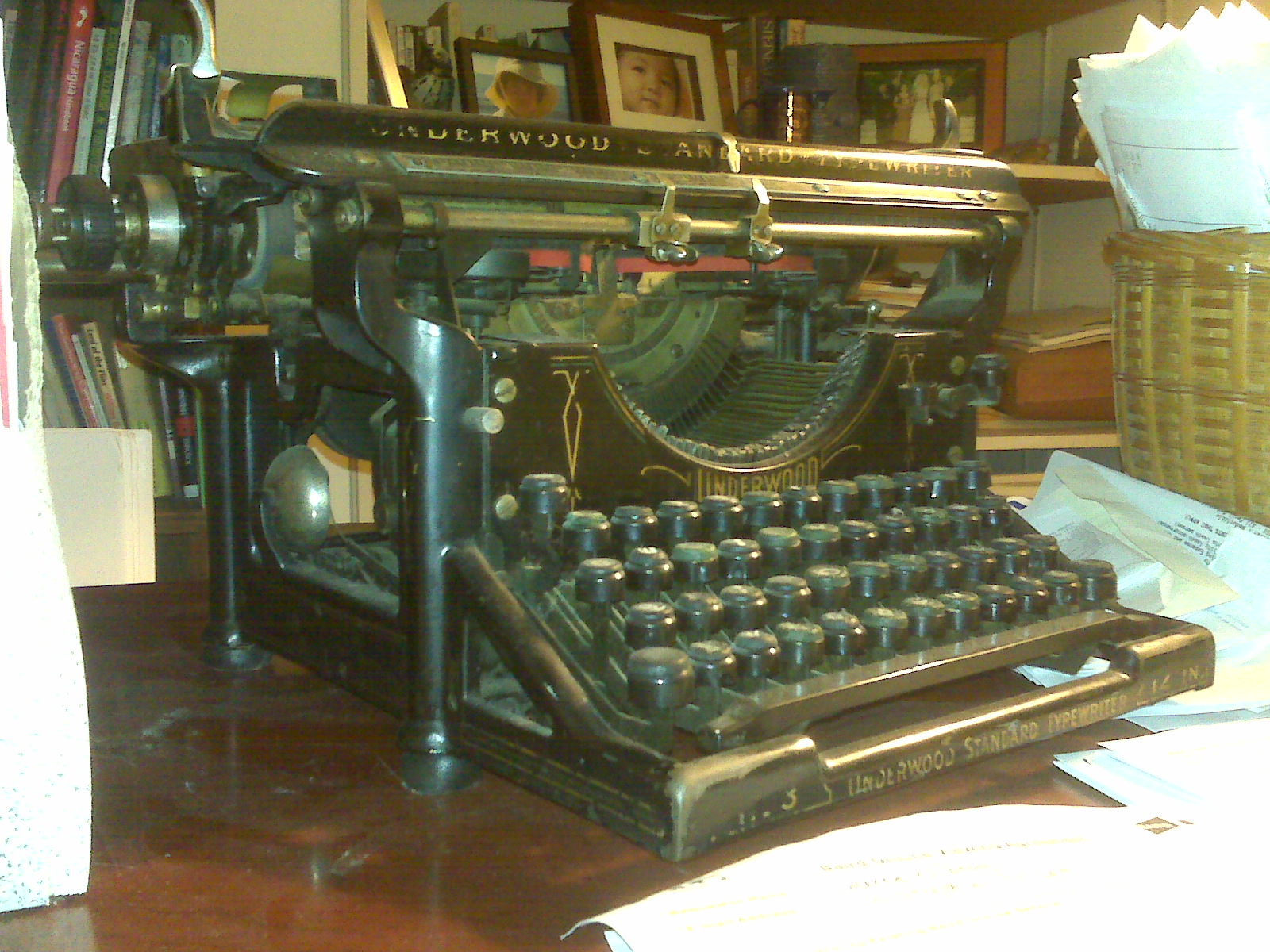
I got in my car and drove six hours to the Michigan town where they lived. When I got there, he was typing out my mother’s obituary notice on his ancient Underwood typewriter.
 He read it out loud. The details of my mother’s life. That she was married for 64 years. That she had three children. And five grandchildren.
Five. My daughter. My brother’s son and daughter. My sister’s two sons. Five.
He asked me, “Does this sound ok to you?” Never having been asked my opinion before, I said, “Yes, it sounds fine.”
“I just want to do the right thing,” he said.
“I know,” I said, sitting on the office chair next to him, watching him pound out the obituary notice. Watching the old keys strike the ribbon, black and red. He could type 80 words a minute on that old thing. And he could zing that carriage back fast as you please.
Five.
But it wasn’t five. It was eight. My mother had eight grandchildren. The five birth children, if you will, and the three my husband and I adopted from Nicaragua. Eight.
I didn’t correct him.
I let it stand. Five.
I basically let my own father forget that he had three additional grandchildren.
I could give reasons for this. That I was tired. That I didn’t want to get into it as we say. That it wasn’t the time.
That I was equivocal in my own heart is the last reason I would recognize.
This isn’t a story that has a good resolution. I never corrected him. My dear daughter (birth) dropped everything and came from California to tend to us, make lasagna, and sooth everyone. My other kids (adopted) piled in the car with their dad and made the mad dash from Milwaukee to our little town in Michigan.
They all stood behind me at the cemetery.
They never knew.


Snow Door | wisconsinacademy.org
Listen to Jan read her essay “Billy” presented on WUWM’s Lake Effect

Jan’s essay “At the Breakfast Bar” on WUWM Lake Effect

Jan’s essay “The Parish Hall,” on WUWM Lake Effect


“Fury Cannot Touch Me,” Modern Love, NYT, 9/29/11

Recent Comments